Teaching
Teaching philosophy in brief
Most students don’t struggle with mathematics because it’s hard; they struggle because it’s invisible. An eigenvector, a finite field, an elliptic curve — these feel abstract only until you can see one move. My teaching is built around making the invisible visible: good pictures, concrete examples first, and interactive tools that let students experiment before they formalize.
I aim for classrooms — physical or virtual — where it’s safe to be confused out loud, where every abstraction is anchored to something you can compute or draw, and where students leave able to use an idea, not just recite it.
The best demonstration of this is the interactive elliptic-curve project: a crash course where the lectures are applets you can manipulate, not slides you watch.
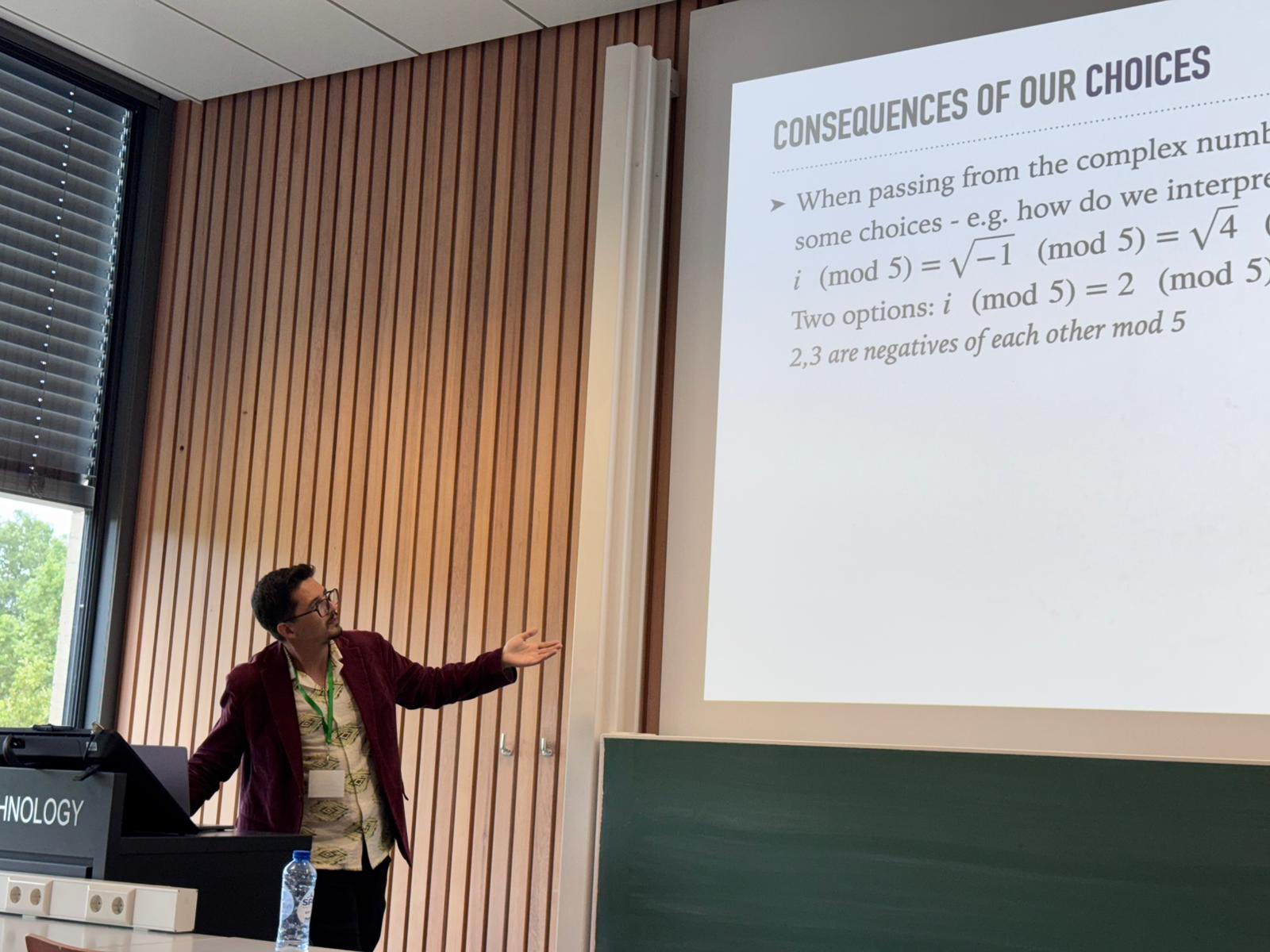
Experience
- Lecturer, UC Santa Barbara (2020–2022) — Linear algebra, vector calculus, and calculus for the social sciences. Designed and ran my first year entirely remotely over Zoom; class sizes ranged from 30 to 300 students.
- Instructor of Record, UC Santa Barbara (Summer 2018) — Full responsibility for course design, delivery, and assessment.
- Teaching Assistant, UC Santa Barbara (2014–2020) — Discussion sections, grading, and office hours across the calculus and linear-algebra sequence.
- Project Mentor & TA, The Erdős Institute (2024–2025) — Remote mentoring of data-science and machine-learning projects for early-career researchers.
- Private tutoring, Seattle — College algebra, statistics, and probability, largely with adult and returning learners.
Mentoring
- REU Project Leader, UC Santa Barbara (2019) — Led an undergraduate research project.
- Directed Reading Program mentor, UC Santa Barbara (2018–2022) — Guided undergraduates through semester-long independent reading projects.
Teaching statement available on request — please email me.